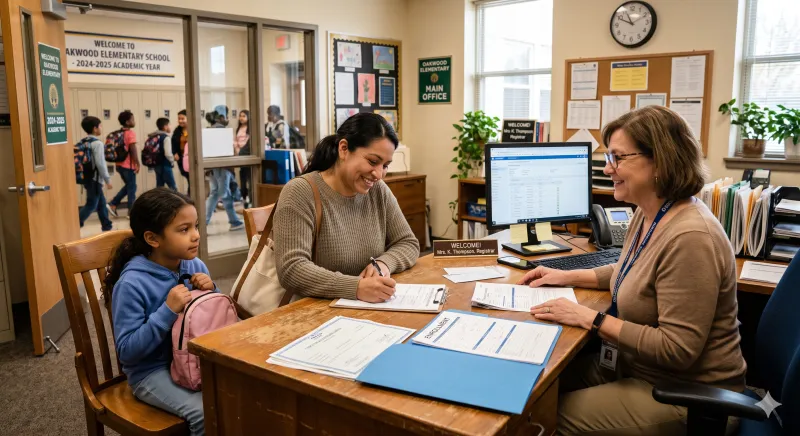
Yes, you absolutely can enroll a child in school in the middle of the year. Life doesn't always wait for summer break—whether you're relocating for a new job, dealing with family changes, or simply finding that your current school isn't the right fit, mid-year school transfers happen all the time.
Schools are well-equipped to handle mid-term transitions, but navigating the logistics requires a bit of prep work. Here is everything you need to know about enrolling your child mid-year, including the legal rights you have, the paperwork you'll need, and how to make the switch as smooth as possible.
📋 The Mid-Year School Enrollment Checklist
When transferring schools outside the normal enrollment window, having your documentation ready beforehand is the best way to avoid delays. Public schools are legally obligated to enroll students who live within their boundaries, but they cannot finalize it without specific records.
1.Gather Proof of Residency:Step 1.Most districts require two forms of proof that you live within their boundaries. Gather a recent utility bill (gas, electric, or water), a lease agreement, or a mortgage statement document.
2.Request Official Transcripts:Step 2.Contact your child's current school to request official transcripts, report cards, and attendance records. If your child has an IEP (Individualized Education Program) or a 504 Plan, request those files explicitly.
3.Obtain Health & Immunization Records:Step 3.Schools cannot legally let a child attend classes without up-to-date immunization records. Grab a copy of your child's vaccine card and their most recent physical exam from your pediatrician.
4.Submit the Registration Packet:Step 4.Visit the new school district’s enrollment portal or central office. Submit your proofs of residency, identity (birth certificate), and academic records to officially secure their spot.
🔍 Key Considerations: Public vs. Private vs. Charter Schools
The rules for mid-year enrollment change depending on the type of school you are looking at:
1. Traditional Public Schools
If you move into a new school district, the local neighborhood public school must accept your child, regardless of the time of year. Under federal law, children have a right to a free public education. However, if you want to switch to a public school outside your resident zone (intra-district transfer), acceptance depends entirely on whether that specific school has open seats.
2. Charter Schools
Charter schools are publicly funded but independently run. They accept mid-year transfers only if they have open seats. If the school is at maximum capacity, your child will likely be placed on a waiting list, meaning you will need to enroll them in your local public school in the meantime.
3. Private Schools
Private schools have complete autonomy over their enrollment dates. Many will happily accept mid-year transfers if they have space and if the student passes their admissions criteria. Keep in mind that tuition is rarely fully prorated, so ask about financial obligations upfront.
A Note on the McKinney-Vento Act: If your mid-year move is due to housing instability, homelessness, or economic hardship, the federal McKinney-Vento Act protects your child's right to immediate enrollment—even if you lack standard documents like proof of residency or immunization records.
🧠 Helping Your Child Adjust: The Social-Emotional Side
Enrolling academically is only half the battle; the emotional transition can be tough on kids. Walking into a classroom where friendships and routines have already been established for months requires a lot of resilience.
- Acknowledge Their Feelings: It’s normal for kids to feel anxious, angry, or sad about leaving their old friends. Validate those emotions rather than just telling them to "look on the bright side."
- Meet the Teacher Early: If possible, tour the school and meet the teacher a day or two before your child’s first official day. Seeing the layout of the classroom and knowing where the bathroom is can drastically lower day-one anxiety.
- Keep Up with Extracurriculars: If your child loves soccer, art, or gymnastics, get them plugged into local clubs right away. Making friends outside the classroom makes building a new social circle feel much less daunting.