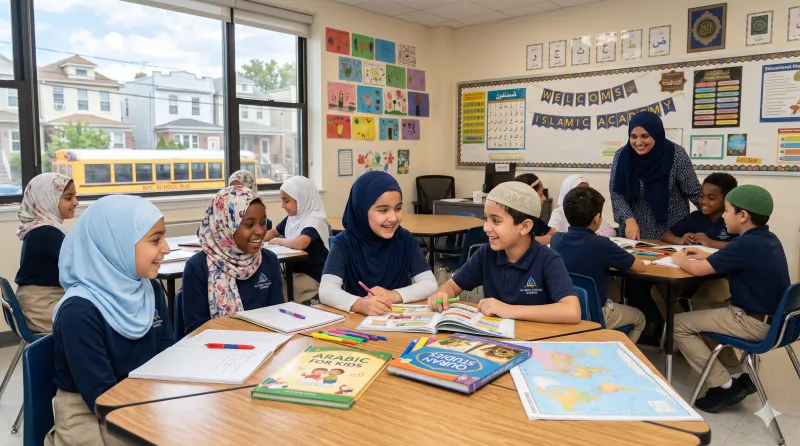
For Muslim families living in New York City, balancing high-quality academic education with strong spiritual and moral development is a top priority. Queens, being one of the most ethnically and culturally diverse boroughs in the world, is home to a vibrant, thriving Muslim community. To serve this community, several exceptional private faith-based institutions have established themselves across the borough, offering New York State-approved curricula alongside comprehensive Islamic studies, Quran memorization, and Arabic language programs.
Finding the right private Islamic school in Queens, NYC requires looking at academic standards, campus environments, location, and how deeply faith-based values are integrated into daily learning. This guide breaks down everything you need to know to make an informed decision for your child's future.
Why Enroll Your Child in a Private Islamic School in Queens?
Enrolling your child in a private faith-based institution offers distinct advantages that public schools simply cannot provide. In a bustling urban environment like New York City, these schools act as safe havens that protect and nurture a child's identity during their most formative years.
Holistic Identity Formation
Children spend their formative years surrounded by peers and educators who share their values. This builds a deep, unshakeable confidence in their American Muslim identity, allowing them to navigate the wider world with a clear sense of self and purpose.
Academic Excellence with Spiritual Depth
Top private institutions do not compromise on secular education. They implement rigorous state standards, advanced science and math tracks, and thorough preparation for higher education while dedicating intentional time to spiritual growth and daily prayers.
Character Development (Akhlaq)
Beyond textbook knowledge, these schools place immense focus on teaching moral character, community service, respect, and compassion rooted in the prophetic tradition. This holistic approach ensures that students grow academically while developing excellent manners.
A Built-In Community Network
Families who join these schools become part of a tightly-knit network of parents and educators working toward the same goal: raising responsible, successful, and faithful citizens who contribute positively to society.
Key Features of a Premium Islamic Curriculum
A high-quality private school in New York City does not simply tack an Islamic studies class onto the end of a public school schedule. Instead, faith is woven naturally into the entire academic fabric throughout the school day.
The Secular Academic Track
To remain competitive, top-tier private schools fully implement the New York State Next Generation Learning Standards. Students take standard courses in English Language Arts (ELA), Mathematics, Social Studies, and laboratory sciences. High schools focus heavily on preparing students for the New York State Regents Examinations, ensuring high graduation rates and placements into top universities and colleges.
Integrated Islamic Studies
This core branch of the curriculum covers Islamic history, jurisprudence, theology, and daily practices. The goal is to provide students with practical knowledge they can apply to real-world modern dilemmas, allowing them to navigate society with a strong ethical compass.
Quranic Memorization and Recitation
Schools dedicate specific periods of the day to the Holy Quran. Students are taught the correct rules of pronunciation and articulation while working through structured memorization goals tailored to their age, speed, and individual capability.
Classical Arabic Language Program
Understanding Arabic is vital to unlocking the deeper meanings of traditional texts. Private programs focus on building reading, writing, and conversational skills from a young age, often counting toward foreign language credits required for graduation.
What to Consider When Choosing the Right School
Selecting the right environment for your child requires evaluating multiple practical and philosophical factors to ensure a good match for your family's needs.
First, consider the grade alignment of the institution. Decide if you prefer a continuous kindergarten through twelfth-grade environment where your child can grow up in one consistent place, or an elementary-focused academy that specializes deeply in early childhood development.
Second, verify the school's official accreditation. It is vital to ensure the institution is fully recognized and approved by the New York State Education Department so that all academic credits, transcripts, and diplomas are completely official and accepted by higher education institutions.
Third, look closely at class sizes and student-to-teacher ratios. Lower student-teacher ratios mean educators can provide personalized academic support, address learning gaps quickly, and offer better personal character mentorship.
Fourth, account for daily transportation and logistics. New York City traffic can make daily commutes difficult. Inquire if the institution offers private bus routes, or if it qualifies for the standard New York City free student MetroCards for public transit.
Finally, evaluate the available extracurricular activities. Check if the school offers sports clubs, arts and crafts, technology or coding clubs, and community service initiatives to help build a well-rounded student profile for future college applications.
Navigating the Admissions Process Successfully
Admissions for private faith-based schools in New York City typically open early in the winter or spring for the following upcoming academic year. Because seats are often limited due to strict class size policies, early application is highly recommended to secure a spot.
The first step is always scheduling a formal school tour or attending an open house. This allows you to observe the daily atmosphere, see how students interact with teachers, and look at the cleanliness, security, and safety of the facility.
Once you select a school, you will submit an application along with standard documentation, including birth certificates, up-to-date immunization and health records, and previous school report cards or progress reports.
Most private schools will then conduct basic diagnostic testing in Mathematics and English reading comprehension to ensure your child is placed in the correct academic tier. This is usually followed by a brief family interview to ensure that parent expectations align directly with the school’s behavioral policies, code of conduct, and educational philosophy.