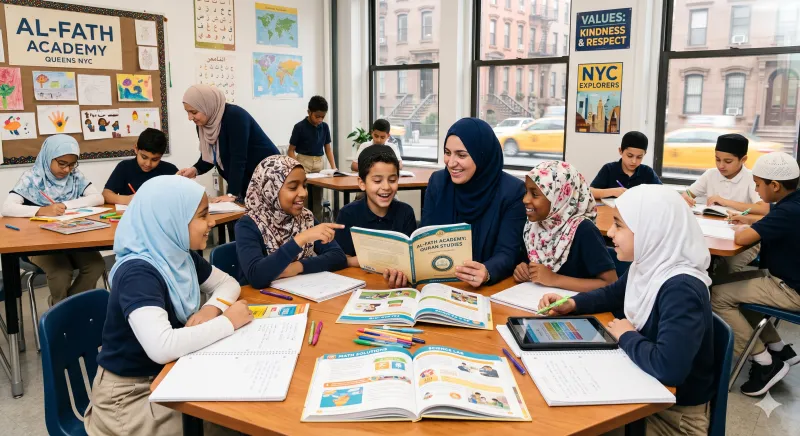
For Muslim families across New York City and the surrounding metropolitan area, choosing the right educational setting is one of the most significant decisions they will ever make. Parents frequently look for private environments that refuse to compromise on rigorous academic preparation while simultaneously providing a deep, meaningful foundation in faith, spiritual identity, and moral character. New York is home to a dynamic and expansive community, which has naturally led to the development of several high-achieving, private faith-based schools designed to help students excel both in this world and the next.
Selecting a premium private academy requires analyzing how an institution manages state-aligned academic milestones, how deeply it integrates spiritual practices into the standard daily routine, and the overall supportive culture of the school campus. This guide explores the foundational elements of these institutions and details key factors parents must consider when identifying the right fit for their children.
The Compelling Benefits of Private Faith-Integrated Education
Enrolling a child in a private faith-based school in a fast-paced urban center like New York provides a variety of distinct advantages that extend far beyond traditional classroom learning.
Unshakeable Identity Formation
During their early developmental years, children are highly susceptible to peer influences and cultural environments. Spending the school day surrounded by educators, mentors, and classmates who share their values helps students establish a resilient, confident American Muslim identity. This secure sense of self empowers them to engage with the broader world with clarity, confidence, and immense pride in their heritage.
Seamless Integration of Knowledge
Rather than treating spiritual growth as an isolated subject taught at home or on weekends, private academies naturally weave faith into the entire educational fabric. Students learn to see the world through a balanced lens where scientific discovery, mathematical reasoning, historical analysis, and spiritual wisdom complement one another, fostering deep intellectual and personal development.
Uncompromising Focus on Character (Akhlaq)
A true education does not simply focus on achieving top grades; it actively molds the human heart. Premium private institutions place an immense emphasis on the cultivation of excellent manners, personal integrity, empathy, and social responsibility. By mirroring the honorable character traits found in prophetic histories, students are taught to prioritize respect, kindness, and community service in their daily interactions.
Smaller Class Sizes and Strong Mentorship
Private day schools across the metropolitan area typically maintain lower student-to-teacher ratios than public institutions. This lower ratio ensures that classroom environments remain calm, structured, and highly focused. It also enables teachers to offer individualized academic interventions, accommodate diverse learning styles, and build strong mentoring relationships that keep students accountable and motivated.
Core Pillars of a Premium Academic and Spiritual Curriculum
The leading private faith-based institutions throughout New York follow a balanced, dual-curriculum model that ensures complete preparation for future college programs alongside thorough spiritual literacy.
Rigorous Secular Standards
To guarantee complete competitiveness in higher education, top-tier private schools fully implement local and state educational frameworks, including advanced pathways in English Language Arts, Mathematics, Social Studies, and laboratory sciences. Upper-grade levels focus extensively on preparing students for official state secondary examinations, ensuring excellent graduation rates and placements into respected competitive colleges and universities nationwide.
Classical Linguistics and Arabic Literacy
A foundational component of heritage-based private education is establishing strong reading, writing, and conversational skills in the Arabic language. Starting from early childhood programs, schools introduce structured language tracking to help students develop the capability to study historical, legal, and traditional texts independently.
Scriptural Articulation and Memorization
Daily schedules include dedicated instructional blocks focused entirely on sacred texts. Specialized teachers guide students through the correct rules of pronunciation, rhythm, and phonetics. These programs are carefully designed to meet students at their current individual skill levels, allowing them to memorize and review text at a comfortable, successful pace that builds internal discipline.
Applied Theology and Ethics
Religious education in a premier school moves beyond simple memorization to focus heavily on practical application. Students explore history, theology, and ethical frameworks to learn how to apply traditional principles to modern-day challenges, equipping them with a dependable moral compass to navigate complex societal scenarios safely.
Essential Evaluation Factors for New York Families
Because every student has unique needs and every household manages different daily routines, parents should carefully review several practical and structural criteria before finalizing an application.
First, evaluate the grade continuity and structure of the school. Some parents prefer a single, stable K-12 campus where a child can remain from preschool through high school graduation, building deep lifelong friendships within a singular community. Other families may choose specialized elementary or middle school academies that focus exclusively on early childhood development before transitioning students into larger secondary schools.
Second, verify the institution's official accreditation status. It is highly critical to ensure that any private day school under consideration is officially registered and fully recognized by the state's education department. Proper accreditation guarantees that all earned credits, student transcripts, and high school diplomas are fully valid and readily accepted by colleges, universities, and professional institutions across the country.
Third, look into campus facilities, resources, and extracurricular activities. A well-rounded educational experience requires resources that extend beyond standard desks and whiteboards. When exploring private options, look for campuses that feature updated science labs, computer rooms, comfortable prayer spaces, outdoor recreational facilities, and clubs such as coding, athletics, public speaking, or charity drives that foster teamwork and leadership.
Finally, calculate the daily commute and logistical feasibility. Navigating New York's traffic and expansive geography requires practical planning. Parents must inquire whether an institution operates its own private, secure school bus routes through specific neighborhoods, or if older students qualify for public transit student passes to ensure a safe, reliable, and stress-free journey to school each morning.
The Standard Private School Admissions Pathway
Securing a seat in a highly rated private academy requires proactive planning, as registration windows often open early in the winter or spring months for the following autumn term, and space is frequently limited to protect low student-teacher ratios.
The process universally begins with attending a scheduled open house or booking an official campus tour. This step is vital because it allows parents to inspect classroom cleanliness, observe security measures, and witness firsthand how teachers interact with and manage students throughout the day.
Following a successful visit, parents submit a formal enrollment application along with necessary personal records, including official birth certificates, up-to-date medical and immunization forms, and past progress reports or school transcripts.
To ensure correct classroom placement and academic support, most schools require applicants to complete a gentle diagnostic evaluation checking reading comprehension and mathematical readiness. The final step is typically a warm family interview, which allows school administrators and parents to ensure that household expectations, parental support, and the academy's educational philosophy are perfectly aligned for a collaborative, successful school year.