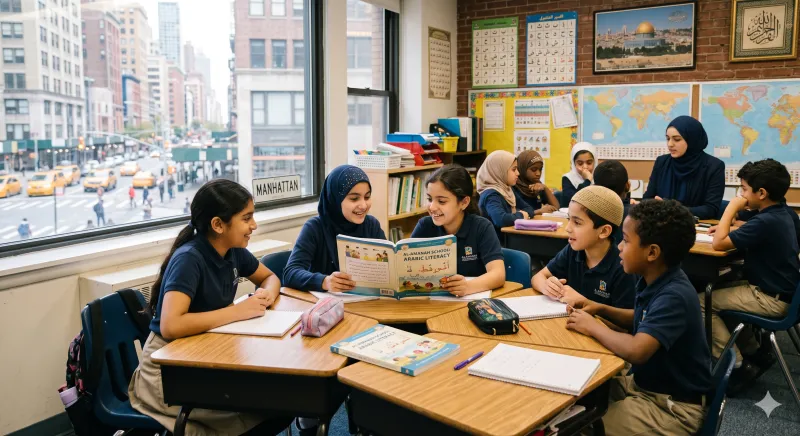
For families residing in the heart of New York City, balancing the fast-paced, high-energy environment of Manhattan with a grounded upbringing for their children is a unique journey. Finding an educational setting that offers top-tier academic training while reinforcing strong spiritual, cultural, and moral foundations is a high priority for many households. While surrounding boroughs like Queens and Brooklyn feature large, sprawling residential campuses, Manhattan offers highly specialized private faith-based programs and day academies tailored to families seeking a holistic education within the city’s primary cultural and economic hub.
Choosing a private Islamic school or faith-integrated academy in Manhattan requires evaluating how an institution blends rigorous state-aligned secular learning with character development, language fluency, and a supportive community atmosphere. This guide explores the core pillars of these urban institutions and details the essential factors parents should consider when planning their child's academic future.
The Strategic Value of Faith-Based Education in an Urban Core
Enrolling a child in a private faith-based academy in Manhattan provides distinct environmental and developmental advantages that help students navigate the complexities of growing up in a major global metropolis.
Cultivating a Grounded Identity
Manhattan is a center of diverse ideas, fast-paced lifestyles, and constant sensory input. For children in their formative years, spending the school day in an environment that consistently reinforces core family values is incredibly beneficial. These institutions help students build a resilient, confident American Muslim identity, allowing them to engage with the broader city around them from a position of security, self-worth, and moral clarity.
Rigorous Academics with Ethical Context
Premium private schools do not compromise on foundational education. They implement structured curricula designed to meet and exceed local educational frameworks, ensuring mastery in mathematics, reading comprehension, critical writing, and scientific inquiry. However, unlike entirely secular environments, these academies teach subjects within an ethical framework, encouraging students to use their knowledge to contribute positively to human society.
Deliberate Focus on Character (Akhlaq)
A core objective of private faith-based schooling is the intentional cultivation of excellent manners, personal integrity, humility, and compassion. Education is viewed as a holistic process that goes far beyond test scores to actively shape a child's daily behavior. Students are taught to prioritize respect for elders, kindness to peers, and regular community service as practical expressions of their faith.
Close Mentorship in Smaller Settings
Because space in Manhattan is carefully utilized, private academies in the borough often feature smaller, highly focused learning environments. This naturally leads to lower student-to-teacher ratios, ensuring that classrooms remain orderly and deeply engaging. Teachers can provide personalized academic attention, identify individual learning styles, and build strong mentoring relationships that keep students motivated and accountable.
Core Elements of an Integrated Academic and Spiritual Curriculum
The leading private programs available to Manhattan families utilize a balanced, dual-curriculum model that fully prepares students for future educational advancement while ensuring thorough literacy in traditional foundational studies.
Comprehensive Secular Tracks
To guarantee complete competitiveness for future admissions into selective secondary schools and universities, private day schools implement rigorous standards in English Language Arts, Advanced Mathematics, Social Studies, and Sciences. Instructors focus heavily on critical thinking, public speaking, and digital literacy, preparing students to excel in modern, tech-driven academic fields.
Classical Linguistics and Arabic Fluency
A foundational component of heritage-based private education is establishing a functional command of the Arabic language. Beginning in early childhood programs, schools introduce structured language tracking aimed at building reading, writing, and conversational skills, allowing children to connect directly and independently with traditional and historical texts.
Scriptural Literacy and Articulation
Dedicated instructional blocks throughout the week are focused entirely on sacred texts. Specialized instructors guide students through the precise rules of pronunciation, rhythm, and phonetics. These programs are carefully tailored to meet students at their current individual capability levels, encouraging steady memorization, review, and personal reflection at a successful, stress-free pace.
Practical Ethics and History
Religious education moves past simple memorization to focus heavily on real-world application. Students explore history, jurisprudence, and theology to understand how traditional ethical frameworks apply to modern everyday dilemmas, equipping them with a dependable moral compass to make responsible choices in an increasingly complex world.
Essential Considerations for Manhattan Parents
Because daily routines in Manhattan involve distinct logistical and structural dynamics, parents should carefully analyze several practical criteria before finalizing an enrollment application.
First, consider the grade alignment and layout of the program. Many private programs operating in Manhattan specialize heavily in early childhood development, preschool, and elementary education. These institutions focus entirely on building a rock-solid cognitive and moral foundation during a child's most adaptable years, preparing them smoothly for the transition into larger secondary environments later on.
Second, verify the school's official registration and accreditation status. It is highly critical to ensure that any private day school under consideration is officially recognized by the state's education department. Proper certification guarantees that all academic records, student transcripts, and completed grade tiers are fully valid and readily accepted by other private or public institutions nationwide.
Third, look closely at how the school utilizes urban space and extracurricular resources. While Manhattan campuses may not always feature expansive, multi-acre sports fields, premier institutions maximize their space beautifully with modern computer labs, clean and dedicated prayer halls, creative art studios, and strong partnerships with local community centers. Look for schools that offer enriching clubs, such as coding, debating, or charity distribution networks, which foster leadership and teamwork.
Finally, account for the daily commute and transportation logistics. Navigating Manhattan traffic requires consistent, safe planning. Parents should explore the school's proximity to public transit lines, look into whether the institution coordinates dedicated local van pools, or check if students qualify for municipal student transit passes to ensure a reliable and stress-free journey to school each morning.
Navigating the Enrollment Process Successfully
Securing placement in a reputable private academy requires timely preparation, as seats are frequently limited to preserve low student-to-teacher ratios and ensure high-quality individual instruction.
The pathway universally begins with scheduling an official campus visit or attending a school open house. This step is vital because it allows parents to inspect the safety and security protocols of the facility, observe classroom dynamics firsthand, and see how educators interact with and manage students throughout the instructional day.
Following a successful visit, parents submit a formal enrollment application along with necessary personal and academic records, including official birth certificates, up-to-date medical and immunization forms, and past progress reports or developmental evaluations.
To ensure correct classroom placement and verify academic readiness, most schools require applicants to complete a gentle diagnostic assessment reviewing age-appropriate reading and mathematical foundations. The final step is typically a warm family interview, which gives school administrators and parents an opportunity to ensure that household expectations, parental involvement, and the academy's educational philosophy are fully aligned for a collaborative, successful school year.