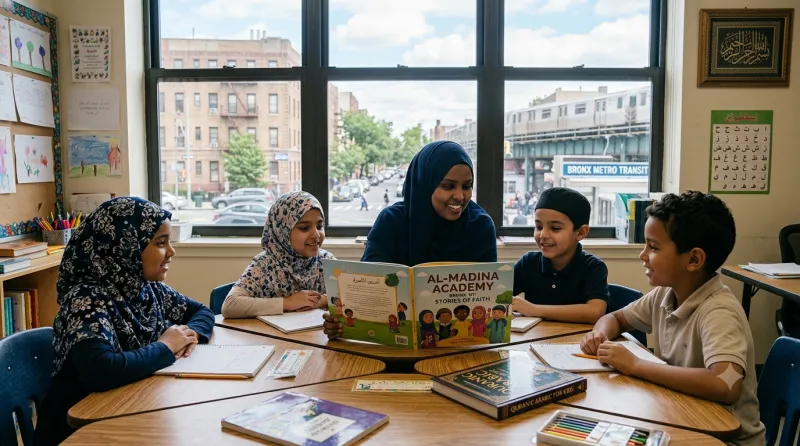
For Muslim families living in the Bronx, providing children with an education that excels academically while fostering deep moral and spiritual integrity is a primary goal. As one of New York City’s most energetic and culturally rich boroughs, the Bronx has seen a beautiful growth in its Muslim community over recent decades. To support this expanding population, several private faith-based schools and educational academies have established roots, offering localized, family-oriented learning spaces designed to nurture young minds and hearts.
Choosing a private Islamic school or a faith-integrated academy in the Bronx means looking at how an institution aligns its secular curriculum with traditional character development, language programs, and community-driven values. This guide explores the foundational elements of these private borough academies and details the essential aspects families should consider when selecting a school.
The Core Advantages of a Faith-Integrated Education in the Bronx
Enrolling your child in a private faith-based institution provides distinctive structural and environmental benefits that help students develop into balanced, successful individuals within a bustling urban setting.
Strengthening Personal Identity and Confidence
The formative school years are critical for a child's self-image. Being surrounded daily by peers, mentors, and educators who share and validate their family’s worldview gives children a resilient, unshakeable confidence in their American Muslim identity. This daily support structure empowers them to participate proudly and effectively in the broader pluralistic society of New York City.
High Academic Standards with a Moral Compass
Top-tier private institutions recognize that academic achievement and spiritual literacy must go hand in hand. These academies implement rigorous academic tracks that cover standard core competencies while approaching knowledge through an ethical lens. Students learn to view fields like science, history, and literature not just as subjects to pass, but as pathways to understanding and positively contributing to the world.
Direct Focus on Character and Community Service
A primary objective of private faith-based academies is the development of excellent personal character, or akhlaq. Beyond teaching textbook facts, these schools place immense focus on cultivating empathy, honesty, discipline, and respect for elders and neighbors. Community service and leadership exercises are frequently woven into the school culture, teaching children the practical value of helping others.
Low Student-Teacher Ratios and Mentorship
Private day schools in the borough typically maintain smaller class sizes than their public counterparts. This smaller environment minimizes classroom distractions and creates a calm, focused atmosphere. It also allows teachers to give individualized attention to students who may need extra support, while building deep mentoring relationships that keep students motivated and accountable.
Essential Elements of a Comprehensive Dual Curriculum
The premier private programs accessible to Bronx families follow a structured, dual-curriculum approach, combining comprehensive state-aligned subjects with thorough spiritual literacy.
Rigorous Secular Tracking
To ensure complete competitiveness for high school transitions and future college admissions, private day schools implement rigorous standards in English Language Arts, Mathematics, Social Studies, and laboratory sciences. Middle and upper grades focus heavily on mastering critical thinking, analytical writing, and scientific reasoning to prepare students for advanced secondary milestones.
Classical Linguistics and Arabic Literacy
A foundational component of heritage-based private education is building strong reading, writing, and conversational skills in the Arabic language. Starting from early childhood programs, schools introduce structured language tracking to help students develop the capability to engage with traditional and historical texts independently.
Scriptural Articulation and Memorization
Daily school schedules feature dedicated instructional blocks focused entirely on sacred texts. Specialized teachers guide students through the correct rules of pronunciation, rhythm, and phonetics (tajweed). These programs are carefully designed to accommodate varying skill levels, allowing children to memorize, review, and reflect upon texts at a comfortable, successful pace.
Applied Theology and Ethical Reasoning
Religious education in a quality school moves past simple rote memorization. Students explore history, jurisprudence, and theology to understand how traditional ethical frameworks apply to modern, real-world scenarios, equipping them with a dependable moral compass to navigate complex societal challenges safely.
Key Considerations for Bronx Families
Because every family manages a unique daily routine and every child possesses different educational needs, parents should carefully analyze several practical and structural criteria before finalizing an application.
First, consider the grade range and structural continuity of the school. Some private programs operate as dedicated early childhood or elementary centers, focusing entirely on building a rock-solid cognitive and moral foundation during a child's most adaptable years. Other institutions offer a continuous kindergarten through eighth-grade or high school path, allowing students to grow up within a singular, stable community.
Second, verify the institution's official registration and accreditation status. It is highly critical to ensure that any private day school under consideration is officially recognized by the state's education department. Proper certification guarantees that all earned credits, student transcripts, and completed grade tiers are fully valid and readily accepted by secondary and higher education institutions nationwide.
Third, look closely at campus resources, safety, and extracurricular options. A well-rounded educational experience requires environments that extend beyond standard desks. When exploring options, look for campuses that feature updated technology tools, dedicated prayer spaces, clean recreational areas, and enriching clubs—such as science fairs, public speaking, or charity drives—that foster leadership and teamwork.
Finally, account for the daily commute and transportation logistics. Navigating travel across the Bronx requires practical planning. Parents must inquire whether an institution operates its own private, secure school bus routes through specific neighborhoods, or if older students qualify for student transit passes to ensure a safe, reliable, and stress-free journey to school each morning.
Navigating the Enrollment Process Successfully
Securing a seat in a reputable private academy requires proactive planning, as registration windows often open early in the winter or spring months for the following autumn term, and space is frequently limited to protect low student-teacher ratios.
The pathway universally begins with scheduling an official campus visit or attending a school open house. This step is vital because it allows parents to inspect classroom cleanliness, observe security measures, and witness firsthand how teachers interact with and manage students throughout the instructional day.
Following a successful visit, parents submit a formal enrollment application along with necessary personal and academic records, including official birth certificates, up-to-date medical and immunization forms, and past progress reports or developmental evaluations.
To ensure correct classroom placement and verify academic readiness, most schools require applicants to complete a gentle diagnostic assessment reviewing age-appropriate reading and mathematical foundations. The final step is typically a warm family interview, which gives school administrators and parents an opportunity to ensure that household expectations, parental involvement, and the academy's educational philosophy are fully aligned for a collaborative, successful school year.