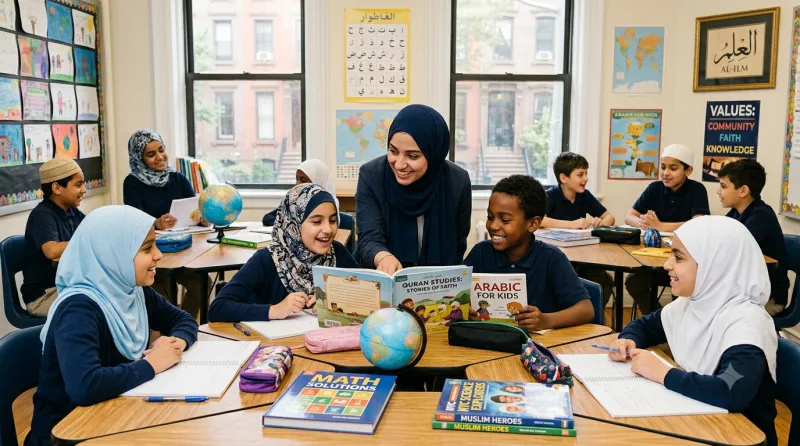
Navigating Affordable and Free Private Islamic Education Options in NYC
For Muslim families living across New York City’s five boroughs, providing children with an environment that balances rigorous academic preparation with authentic moral and spiritual values is often a top priority. However, the cost of private schooling in a major metropolitan center can place a heavy burden on household budgets. When searching for a free or highly affordable "Islamic school near me" in NYC, it is helpful to look at how the community ensures that quality, faith-integrated education remains accessible to all families, regardless of financial standing.
While completely tuition-free private Islamic day schools are rare due to operational costs, the city's network of community centers, mosques, and private academies utilize a beautiful array of financial aid programs, sliding-scale models, and community-funded initiatives to make full-time education virtually free or deeply affordable for qualifying households. This guide details how these structures work and what parents should look for when exploring accessible educational paths.
How NYC Institutions Make Private Education Accessible
To fulfill the collective community obligation of educating the next generation, private faith-based schools throughout the city implement various systems designed to remove financial barriers for families.
Community-Funded Zakat and Financial Aid Programs
The primary way private academies offer near-zero or completely free tuition to low-income families is through community donations, specifically dedicated Zakat (charity) funds. Families facing financial hardships can apply for these internal scholarships during the enrollment process. School boards evaluate financial documentation to cover significant portions—and sometimes up to one hundred percent—of a student's tuition, books, and registration fees.
Income-Based Sliding-Scale Tuition Models
Reflecting the inclusive spirit of community care, several premier private day schools use a sliding-scale tuition program. Rather than charging a flat rate, these schools partner with independent third-party financial aid assessment groups to review a household's annual tax records and income levels. A fair, personalized tuition rate is then calculated, ensuring that lower-income households pay minimal fees that match their actual financial capabilities.
Multi-Child Family Discounts
To support larger households, almost every private faith-based academy in New York offers automatic, tiered discounts for enrolling siblings. Families typically receive a meaningful percentage off the tuition rate for a second child, with even deeper percentage discounts applied for third and fourth siblings, significantly lowering the total cost of attendance for the household.
State-Sponsored Transport and Material Allocations
Even when attending an independent private school, families in New York City benefit from municipal support programs that eliminate daily logistical costs. Qualified private school students receive free student transit passes for public subways and buses, or access to local municipal school bus routes. Additionally, many state-funded text and library loan programs ensure that standard secular textbooks are provided to private students at no cost to the parents.
Core Pillars of a Comprehensive Community Curriculum
Affordable and aid-supported private schools maintain the exact same rigorous educational standards as high-tuition institutions, ensuring complete academic competitiveness alongside thorough spiritual literacy.
Rigorous Secular Standards
To guarantee that students are fully prepared for high school transitions and future university admissions, private academies fully implement official state learning standards. Students cover core subjects including English Language Arts, Advanced Mathematics, Social Studies, and laboratory sciences. Upper grades focus extensively on critical thinking and analytical writing to prepare students for competitive secondary milestones.
Classical Linguistics and Arabic Fluency
A foundational component of heritage-based private education is building strong reading, writing, and conversational skills in the Arabic language. Starting from early childhood programs, schools introduce structured language tracking to help students develop the capability to study historical, legal, and traditional texts independently.
Scriptural Articulation and Memorization
Daily school schedules feature dedicated instructional blocks focused entirely on sacred texts. Specialized teachers guide students through the correct rules of pronunciation, rhythm, and phonetics (tajweed). These programs are carefully designed to accommodate varying skill levels, allowing children to memorize, review, and reflect upon texts at a comfortable, successful pace that builds internal discipline.
Character Development and Ethical Manners
Beyond teaching textbook facts, these schools place an immense focus on cultivating excellent personal character and everyday manners (akhlaq). Education is treated as a holistic process where empathy, honesty, personal discipline, and respect for others are prioritized just as highly as report card grades.
Essential Considerations for Families Exploring Local Options
Because every neighborhood manages different community resources and every household has unique educational goals, parents should carefully analyze several practical criteria before finalizing an application.
First, evaluate the specific criteria of the school's financial aid program. Gather your household's most recent tax returns, income statements, and monthly expense sheets early. Many schools have specific deadlines for financial aid applications that close well before the standard academic year begins, making proactive preparation essential to secure limited scholarship funds.
Second, verify the school's official registration and accreditation status. It is highly critical to ensure that any private day school under consideration is officially recognized by the state's education department. Proper certification guarantees that all academic credits, transcripts, and completed grade tiers are fully valid and readily accepted by other private or public institutions nationwide.
Third, explore localized community center programs as alternatives. If full-time private day school spots are full, many local mosques and cultural centers host highly structured, free, or low-cost after-school and weekend academies. These programs focus entirely on intensive Quranic memorization, Arabic literacy, and Islamic studies, allowing students to attend standard public schools while receiving deep spiritual enrichment nearby.
Navigating the Enrollment and Aid Process
Securing a seat and financial assistance in a reputable private academy requires timely preparation, as aid-supported slots are limited to preserve low student-to-teacher ratios and ensure high-quality individual instruction.
The pathway universally begins with scheduling an official campus visit or attending a school open house. This step is vital because it allows parents to inspect the safety and security protocols of the facility, observe classroom dynamics firsthand, and see how educators interact with and manage students throughout the instructional day.
Following a successful visit, parents submit a formal enrollment application along with necessary personal and academic records, including official birth certificates, up-to-date medical and immunization forms, and past progress reports or developmental evaluations. Concurrently, families submit their separate financial aid or sliding-scale applications through the school's designated assessment platform.
To ensure correct classroom placement and verify academic readiness, most schools require applicants to complete a gentle diagnostic assessment reviewing age-appropriate reading and mathematical foundations. The final step is typically a warm family interview, which gives school administrators and parents an opportunity to ensure that household expectations, parental involvement, and the academy's educational philosophy are fully aligned for a collaborative, successful school year.