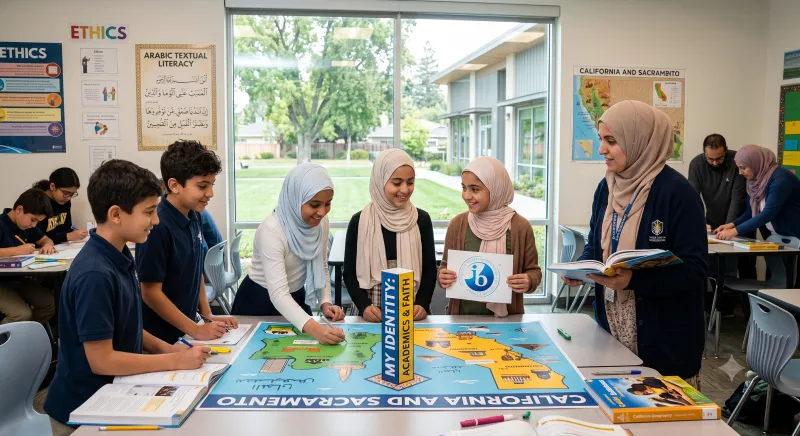
For Muslim families living in California's capital city, balancing a competitive, modern education with the preservation of cultural identity and spiritual values is an essential goal. In Sacramento, full-time Islamic schooling has grown to meet this need, providing an ecosystem where academic standards and personal character development reinforce one another. Rather than compartmentalizing faith to weekends, these institutions offer a daily environment where students can thrive academically while remaining firmly grounded in their heritage.
By serving families across the greater Sacramento metropolitan region, these schools act as vital cultural and educational hubs, shaping confident, principled young people prepared to navigate the modern world.
A Holistic Framework: Advanced Academics Meet Heritage
The core philosophy of Sacramento's full-time Islamic educational model is that high intellectual standards go hand-in-hand with ethical development. The dual curriculum is carefully structured around several foundational pillars:
- Rigorous Academic Standards: Programs deliver a comprehensive curriculum that aligns with California State Content Standards, spanning mathematics, life and physical sciences, language arts, and technology. To prepare students for higher education, advanced programs—such as specialized honors pathways and globally recognized curriculum frameworks like the International Baccalaureate (IB) program—are integrated to challenge students and foster deep critical thinking skills.
- Linguistic and Textual Literacy: Connecting with heritage requires a strong linguistic foundation. Starting from early childhood education, students are taught language literacy, learning to read, write, and converse. This study enables them to build a lifetime link to classical texts, history, and a broader global community.
- Character and Ethical Development: Classroom learning is consistently framed around core moral virtues such as integrity, community service, respect, and responsibility. These values are not taught as abstract concepts but are practiced daily, helping students develop a clear moral compass and a sense of civic duty within their local neighborhoods.
A Vibrant, Community-Driven Foundation
What sets these independent institutions apart is their deeply cooperative infrastructure. Functioning as independent, non-profit entities, full-time Islamic schools in the region rely heavily on the dedication and active involvement of the local community.
While professional educators and certified administrators direct the day-to-day academic schedules and institutional standards, parents and community stakeholders form the backbone of the school’s support systems. From structured parent volunteer organizations to community-funded initiatives, this collaborative effort ensures that the school environment feels like an extension of the home. This strong support network provides the stability and resources necessary to nurture the "whole child," ensuring that the next generation grows up both intellectually capable and culturally secure.